
SEO vs Google Ads for Small Business : Which is better?
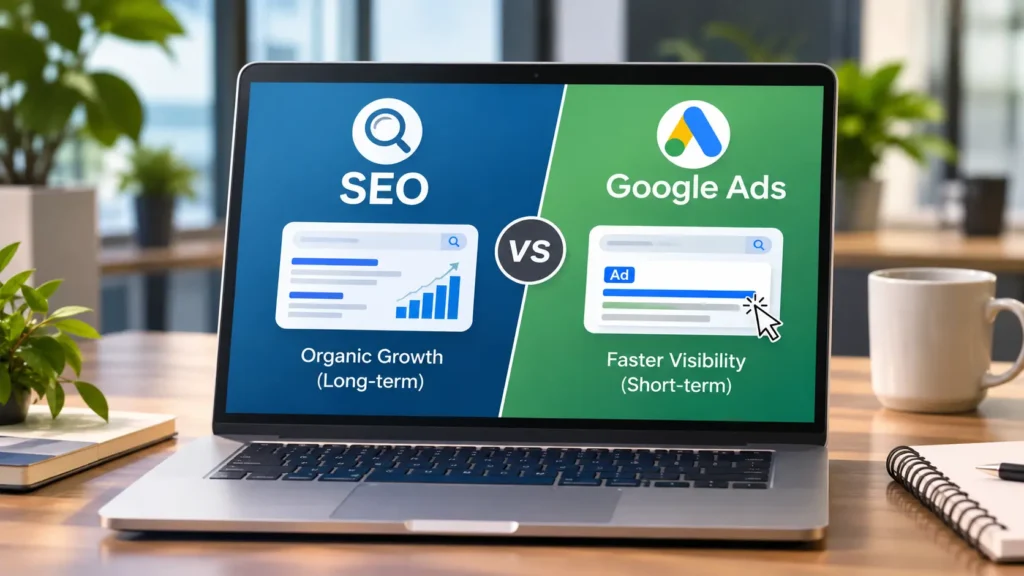
SEO vs Google Ads for small business marketing is a choice almost every owner faces sooner or later, usually when they’re deciding where to put limited time and money.
Both can put you in front of people who are searching for what you offer, but they go about it in very different ways. SEO is about earning a spot in the organic results. Google Ads is about paying for a spot in the ads.
It isn’t always a choice between the two, though. What matters is knowing what each one can do for you, what it costs, and which one suits where your business is right now. This guide covers SEO vs Google Ads for small business marketing in plain language.
What is SEO?
SEO, or search engine optimization, means improving your website so search engines can find it, understand it and show it to people who are looking for answers. In practice that covers technical fixes, keyword research, content, on-page improvements and internal links. Understanding it is the first half of SEO vs Google Ads for small business marketing.
Say a business offers professional services. It could build a page explaining what it does, who it helps and how to get in touch, then publish supporting articles that answer related questions and send readers back to that page.
SEO builds visibility gradually. How well it works depends on your competition, the quality of your site, how relevant your pages are, and a lot more besides. Publishing content or fixing technical problems doesn’t guarantee any particular ranking.
What is Google Ads?
Google Ads is Google’s advertising platform. You create campaigns that can appear in search results and other eligible places. Understanding it is the second half of SEO vs Google Ads for small business marketing.
With search ads, you can reach people who are already looking for something like what you sell. You set a budget, choose who to target, and track actions such as phone calls or form submissions, provided tracking has been set up properly.
The big difference from SEO is that you keep paying for it. Depending on the campaign type, you’re charged when people interact with your ads or when the ads are shown. Campaigns can start getting visibility fairly quickly once they’re approved, but whether they actually work depends on your targeting, your competition, your offer and how good your landing page is.
SEO vs Google Ads for small business marketing: the main differences
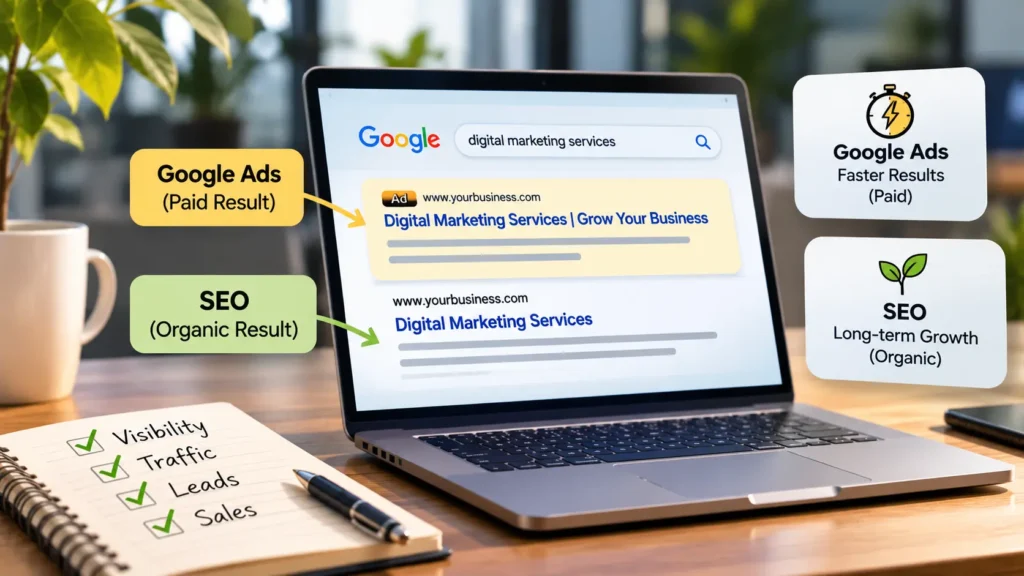
It helps to compare SEO vs Google Ads for small business marketing on three things: what each is for, how it charges you, and how long it takes before you learn what works.
SEO is usually a longer-term investment in how visible your website is in organic results. The costs come from research, technical work, content creation and keeping everything up to date.
Google Ads gives you a quicker way to test demand in paid search. The catch is that the traffic generally depends on the campaign staying active and eligible to run.
Neither one is cheaper or more profitable by default. When you compare SEO vs Google Ads for small business marketing, what counts is whether each one brings in the right people and helps you reach your goals.
When SEO should come first
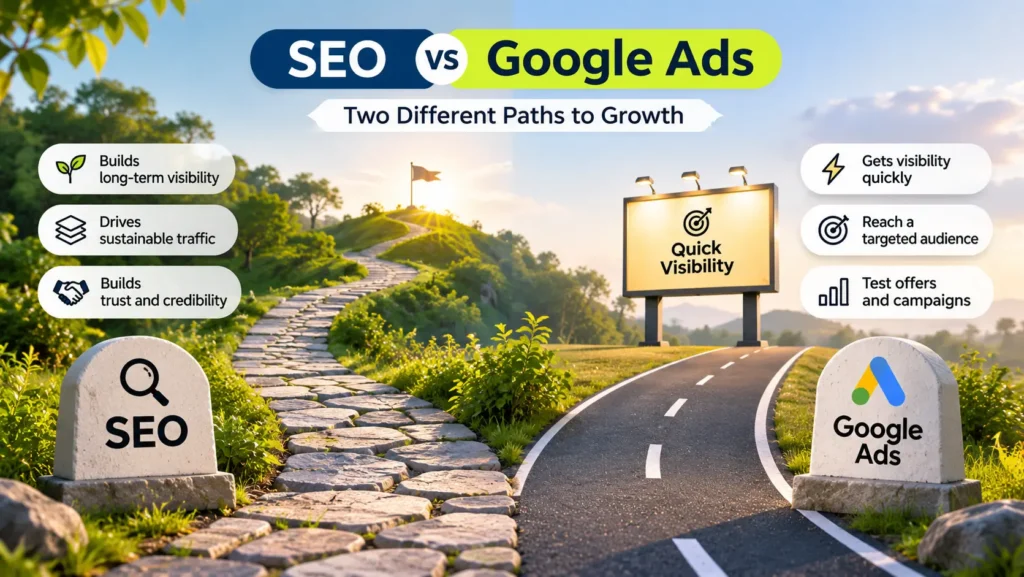
SEO deserves more of your attention when customers regularly search online for what you offer and you want a lasting presence in organic results. In SEO vs Google Ads for small business marketing, this is where SEO usually wins.
Start with the foundahttps://hariprakashk.com/tion. Your important pages should be easy to reach, relevant to the searches you care about, and organized in a way that makes sense to a visitor. After that, you can build content around your services and around the questions people ask before they decide to buy.
For example, a consultant might write a detailed guide on a problem their clients commonly face, then link it to the service that solves it. The article gives people useful information, and the service page explains how you can help.
SEO takes patience. It won’t replace active selling when you need customers this month, and it should be judged over a sensible stretch of time, not after a few days.
When Google Ads makes sense
Google Ads can work well when you want to promote one particular service, test a new offer, or reach people who are actively searching for a solution.
It also teaches you something. You get to see which searches lead to clicks and which ones lead to actual enquiries. That learning is a real advantage in SEO vs Google Ads for small business marketing, where every bit of budget has to count.
Before you spend anything, make sure the campaign has a clear purpose, the right audience, a set budget and a landing page that matches what the ad promises.
Conversion tracking matters more than anything else here. If your goal is enquiries, measure enquiries, and don’t treat every click as a win.
Before raising the budget, look at the search terms people used, the quality of the leads and what each conversion is costing you. A campaign can bring in plenty of traffic and still perform badly if those visitors were never likely to become customers.
SEO vs Google Ads for small business marketing if you serve local customers
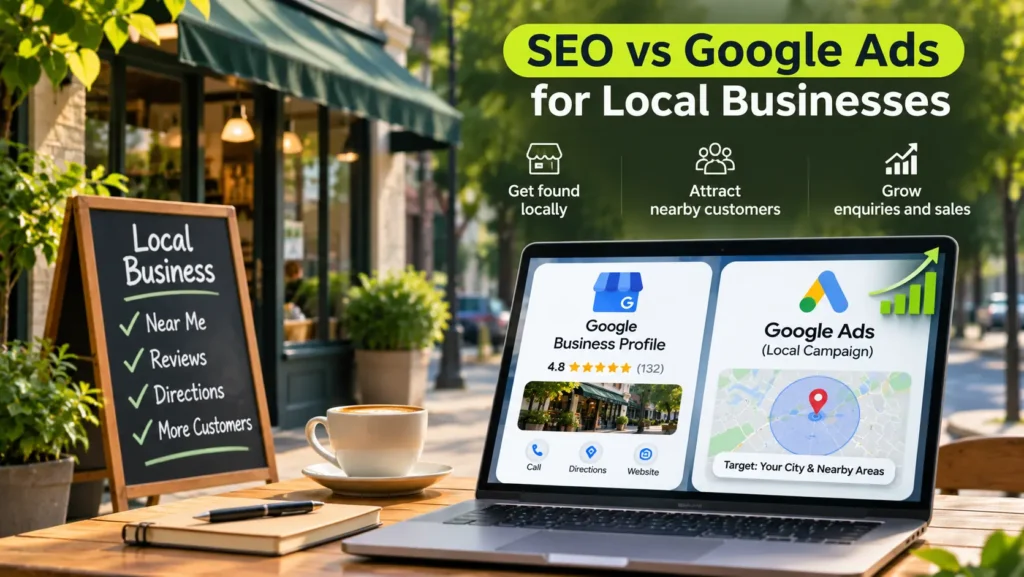
Not every business sells to the whole country. If your customers are in your own town or city and the nearby areas, your marketing should reflect that. Many people searching for a clinic, a restaurant, a tuition centre or a local service type the name of the place along with what they need.
For SEO, local visibility starts with the basics: a clear website, pages that mention the areas you serve, and a complete Google Business Profile with the right address, opening hours, photos and customer reviews. Google’s own Business Profile help pages explain how to set one up.
For Google Ads, you can limit your campaigns to your city and the surrounding areas, so a small budget isn’t spent on clicks from people who can’t visit you. That makes ads a practical way to test a new offer locally.
A sensible order for many local businesses is to sort out the Google Business Profile first, then test a small, location targeted ad campaign while building useful pages over time. That’s one way to approach SEO vs Google Ads for small business marketing when your customers are nearby.
SEO vs Google Ads for small business marketing: what does each cost?
When it comes to the cost of SEO vs Google Ads for small business marketing, there’s no single answer.
SEO doesn’t charge you for each organic click, but earning that visibility isn’t free. Research, content, technical improvements and ongoing optimization all take time or money.
Google Ads means paying for the advertising itself, on top of whatever campaign management and landing page work you need. The total depends on competition, targeting, bidding and how well the campaign converts.
A better way to compare them is to ask what it costs to get one qualified lead, and what a customer from that lead is worth to you.
A campaign with cheap clicks can still be a poor deal if hardly anyone gets in touch. And an SEO page that brings in fewer visitors can be well worth it if those visitors are exactly the right people and many of them enquire. That’s why price alone rarely settles SEO vs Google Ads for small business marketing.
SEO vs Google Ads for small business marketing: can they work together?
Yes, and they often do. In fact, for many small businesses the best answer to SEO vs Google Ads for small business marketing is to use both, with each doing a different job.
Google Ads can help you test offers and spot the search terms that lead to good enquiries. SEO can build your organic visibility around your services and the questions customers have.
Here’s one way to go about it:
- Pick a service that clearly matters to your business.
- Build a landing page that explains the offer well.
- Set up conversion tracking before you launch any ads.
- Review the search terms and lead quality to see where the demand is.
- Create SEO content around that service and improve the page.
- Use what you’ve learned to shape the rest of your marketing.
This way you learn from paid campaigns while building organic assets that keep paying off later, which is a smart way to handle SEO vs Google Ads for small business marketing on a tight budget.
One warning: data from paid search won’t tell you which organic keywords will rank, and running ads doesn’t improve your organic rankings. Judge each channel by the job it’s meant to do.
Common mistakes in SEO vs Google Ads for small business marketing
Expecting SEO results straight away
SEO changes can take a while to show up in your visibility. A short-term bump or dip in rankings isn’t enough to tell you whether the strategy is working.
Running ads without tracking conversions
Without reliable tracking, you can’t tell useful traffic from clicks that never lead anywhere.
Sending everyone to the homepage
Someone searching for a specific service should land on a page about that service. A relevant landing page makes the next step obvious.
Ignoring the quality of enquiries
A pile of enquiries isn’t a good result if most of them are irrelevant or unlikely to turn into customers.
Treating SEO as a one-off job
Websites, competitors and customer needs all change. SEO needs regular attention to content quality, technical health and performance.
How to decide on SEO vs Google Ads for small business marketing
Start by asking what you need right now, how ready your website is, what your budget looks like, and whether you have the capacity to follow up on the enquiries you get.
If your website has serious technical problems or doesn’t explain your services clearly, fix that first. Sending more traffic to a weak site won’t help much, whichever side of SEO vs Google Ads for small business marketing you choose.
If you want to test a specific offer and can measure conversions reliably, a carefully controlled paid campaign could be a good fit.
If you’d rather build lasting organic visibility and answer the questions your potential customers are asking, SEO and content should probably come first.
Many small businesses end up using both in time. What matters is knowing why you’re using each one and how you’ll judge whether it’s working. That’s the practical answer to SEO vs Google Ads for small business marketing.
Final thoughts on SEO vs Google Ads for small business marketing
SEO vs Google Ads for small business marketing comes down to two different ways of reaching people through search. SEO builds organic visibility over time, while Google Ads can bring visibility faster, as long as your campaigns are approved and running.
Neither one guarantees customers, and neither should be judged on traffic alone.
The right choice depends on your goals, your resources, the quality of your website and the value of the enquiries you’re after. That’s the honest answer to SEO vs Google Ads for small business marketing. Start with a clear objective, set up reliable measurement, and put your effort where it makes sense for you today. As you learn more about your audience and your results, you can adjust the balance between organic search and paid ads.